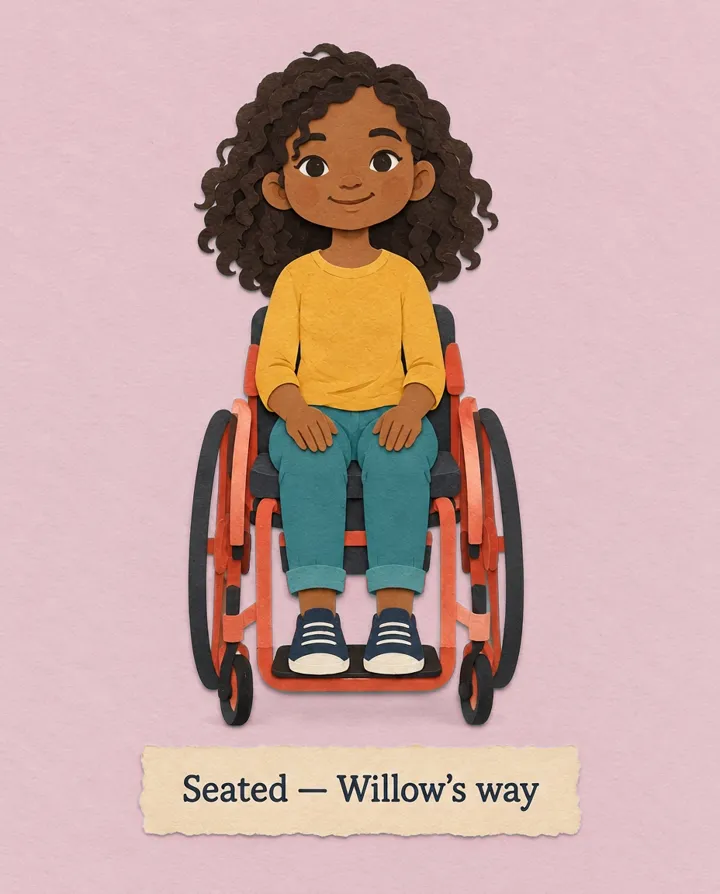
Wheelchair
Seated — Willow's way
Explore Mountain Your Way from a wheelchair, using a comfortable range of movement and the support you choose.
Activity 1 · Body Awareness & Grounding
Finding a comfortable and supported starting position, your way.
Focus
Choose the position that fits this learner today. All three are equally valid.
Wheelchair
Explore Mountain Your Way from a wheelchair, using a comfortable range of movement and the support you choose.
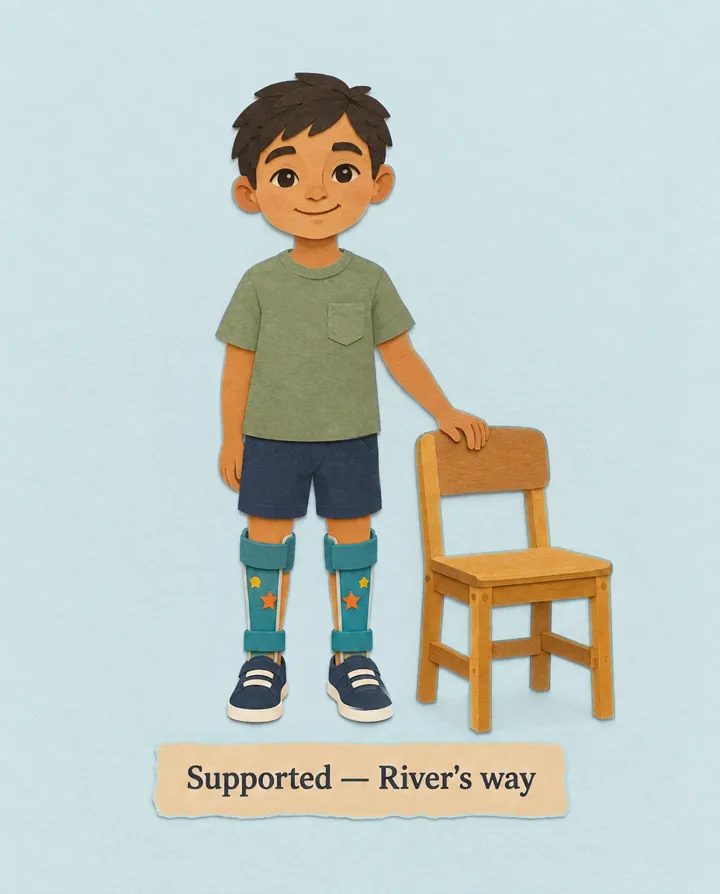
Adapted with support
Explore Mountain Your Way with a chair, wall, helper, or other chosen support. Keep that support as long as needed.
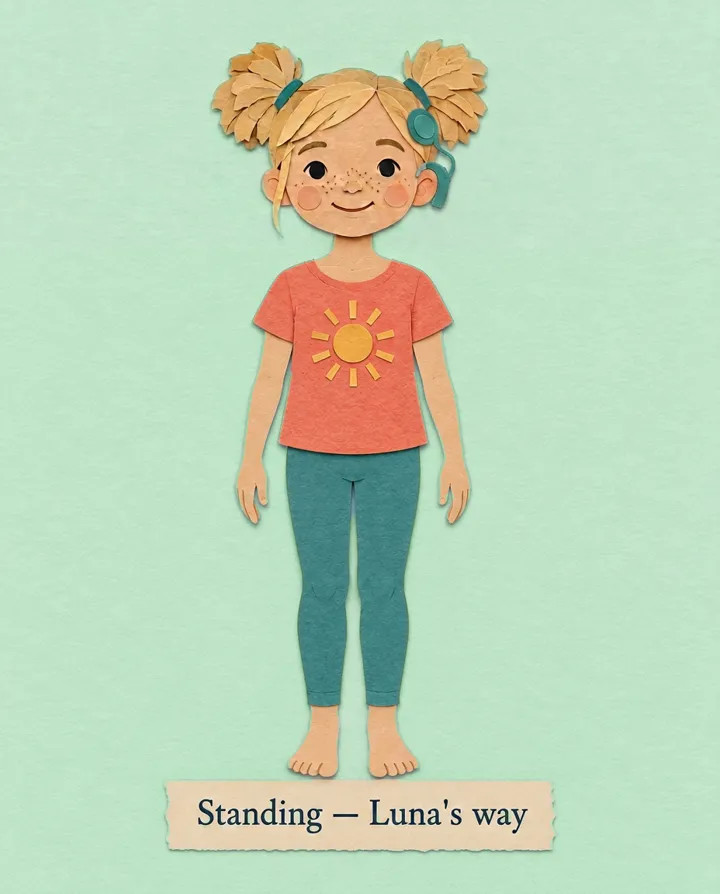
Standing independently
Explore Mountain Your Way while standing if comfortable. Change position, range, or pace whenever needed.
Mountain Your Way introduces the concept of finding a comfortable and supported starting position. Traditional Mountain Pose is often taught as one specific standing posture. In adaptive yoga, Mountain is whatever stable position allows the participant to experience their body as supported and present. Participants may practice standing, sitting in a chair, sitting on the floor, using a wall or mobility support, or another position that works for their body.
Skills this activity may support
Provide enough personal space for each participant to move comfortably. Offer several starting-position options visually or through modeling: Standing • Seated • Supported • Your Way. Avoid positioning participants before they have had an opportunity to explore their own comfortable starting position.
Use these prompts to note what supported participation, not to score a pose.
| Look for | Notes / support to offer next time |
|---|---|
| Did the participant explore a body position? | Space for notes |
| Did they demonstrate awareness of one or more body parts? | Space for notes |
| Did they imitate or independently produce movement? | Space for notes |
| Did they select or create an adaptation? | Space for notes |
| Did they communicate a preference, request, rejection, or need? | Space for notes |
| What appeared to increase or decrease their participation? | Space for notes |
| These observations can help determine what supports to offer next time, rather than determining whether the participant “passed” the activity. | Space for notes |
| Child's choice / request for change |
No materials are required. Optional:
Provide enough personal space for each participant to move comfortably. Offer several starting-position options visually or through modeling: Standing • Seated • Supported • Your Way. Avoid positioning participants before they have had an opportunity to explore their own comfortable starting position.
Invite participants to find their version of Mountain. You might say: “Let's find a position where your body feels supported.” Rather than instructing everyone to place their feet, hands, shoulders, and head in identical positions, encourage exploration.
There is no single correct Mountain. Standing Mountain, seated Mountain, supported Mountain, moving Mountain, and an individually created Mountain can all be meaningful participation.
Find it in
Three ways to participate; How to Teach
Observe how the participant naturally positions their body before offering corrections or assistance. Notice stability, comfort, movement preferences, communication, sensory responses, and environmental needs. Offer options rather than immediately changing the participant's position.
Find it in
What to Observe; Instructor Reminder
Use modeling, gestures, visual supports, simple verbal directions, environmental arrangement, or demonstration. Reduce or increase instructional support based on the participant.
Find it in
How to Teach; Teach the YOGA Way
Change the position, environment, equipment, pace, or movement expectations when needed. The pose adapts to the person. The person does not have to adapt to the pose.
Find it in
Adaptations; Teach the YOGA Way
Perform Mountain standing, seated, kneeling, against a wall, on the floor, or using an individual's typical mobility supports.
Reduce the movement to one body part. For example, raise one hand instead of both arms.
Allow shoes on/off according to preference, provide alternative surfaces, allow movement, or offer preferred sensory supports.
Provide visual choices for stand, sit, help, different, stop, more, and finished. Honor gestures, AAC, body movement, vocalizations, and other communication forms.
Model one movement at a time and reduce verbal language when appropriate.
Participants may sway, rock, bounce, flap, shift their weight, or move while participating.
Reduce visual or auditory distractions, increase personal space, or allow participation from another area of the room.
Do not physically reposition a participant's body without consent. Avoid statements such as “Stand still,” “Fix your feet,” “Hands by your sides,” or “Everyone should look like me.” Instead use language such as:
Naturally model and provide access to: Up • Down • Sit • Stand • Move • Stop • More • Different • Help • Break • My Way • Finished. For AAC users, instructors should model relevant vocabulary without requiring the participant to imitate or select the modeled word.
Instead of asking “Did they perform Mountain correctly?”, observe:
Find a comfortable Mountain position and experience one simple movement.
Move between Mountain and two or more body positions.
Create an individualized Mountain variation or short movement sequence and, if desired, show it to others.
Mountain isn't about standing perfectly still. It's about discovering where your body is and what support helps you feel grounded enough to participate.